
Luggage Size Checker
See how a bag's size compares to common checked and carry-on references, with a live suitcase visual.
About This Tool
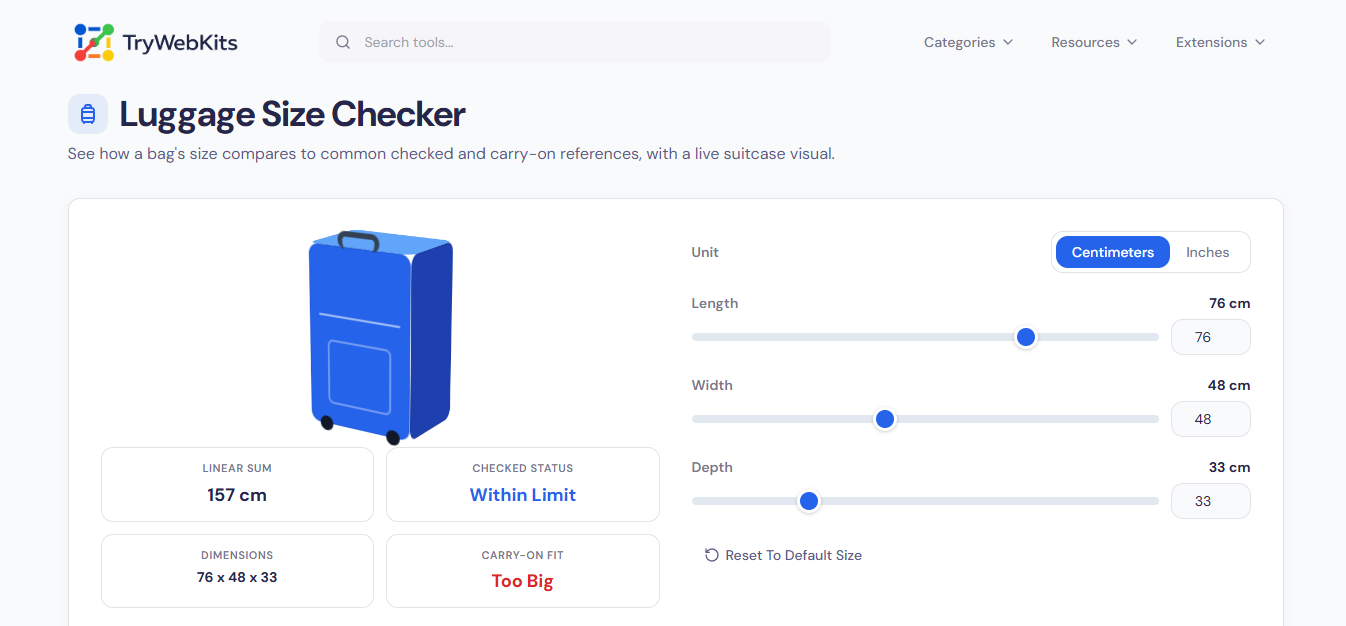
Luggage Size Checker turns three numbers, length, width, and depth, into a live animated suitcase that grows or shrinks as the numbers change, then compares the result against two commonly cited travel size references: a checked-bag linear sum limit and a carry-on size limit. Most travelers judge a bag by feel rather than a strict rulebook, so this tool is built around seeing the size, not just reading a number.
Every airline sets its own exact limits, and this tool does not attempt to replace that. Everything runs locally in the browser, and the last dimensions entered are remembered on the device for the next visit.
How To Measure Luggage Size In Inches Or Centimeters
From a rough guess to a clear side-by-side comparison.
- 1
Drag each slider or type an exact length, width, and depth.
- 2
Watch the suitcase visual scale and change color live.
- 3
Check the Checked Status and Carry-On Fit results.
- 4
Switch units at any time without changing the bag size.
Quick Demo
See how to measure your luggage and check its dimensions.
Cool Features Of This Luggage Size Checker
Animated Suitcase View
A real luggage-shaped visual that scales live with every dimension change, not a plain box.
Inches And Centimeters
Switch units at any time. The bag itself never changes size, only the numbers shown.
Live Checked And Carry-On Status
The checked-bag linear total and the carry-on fit are both checked live as numbers change.
Free-Hand Dimensions
Drag a slider or type an exact number for length, width, and depth independently.
Scroll To Adjust
Hover any slider and scroll the mouse wheel to fine-tune a number without dragging.
Remembers Your Last Bag
The last dimensions and unit choice are saved on the device, so it reopens where it left off.
Common Baggage Size References
These are the most common size categories cited across major airlines worldwide.
| Reference | Centimeters | Inches | Note |
|---|---|---|---|
| International Check-In Baggage | 158 cm | 62 in | The most widely cited linear-sum standard worldwide. Confirm the airline's own weight limit separately. |
| Domestic Check-In Baggage | 158 cm | 62 in | Most domestic carriers use the same size standard as international. Weight allowance is the more common difference. |
| Carry-On (Cabin) Bag | 56 x 36 x 23 cm | 22 x 14 x 9 in | Goes in the overhead bin. Wheels and handles are usually included in this measurement. |
| Personal Item (Hand Bag) | 45 x 35 x 20 cm | 18 x 14 x 8 in | Must fit under the seat in front, separate from the carry-on allowance. |
These are widely cited common reference sizes, not a guarantee for any specific airline. Confirm with the carrier directly before a trip.
Typical Weight Allowances
International Flights
- Most US And European Carriers: around 23 kg (50 lb) in standard economy.
- Many Asian, Middle Eastern, Or African Carriers: often 25 to 35 kg (55 to 77 lb), sometimes even in standard economy.
- Premium Or Business Class: up to 35 to 45 kg (77 to 99 lb) on select carriers.
Domestic Flights
- Budget Or Low-Cost Carriers: 15 to 20 kg (33 to 44 lb).
- Standard Full-Service Carriers: around 23 kg (50 lb), usually the same as international economy.
- Some Regional Routes And Larger Aircraft: can reach 30 to 35 kg (66 to 77 lb), depending on the specific airline and route.
Weight allowance depends more on the specific airline and route than on domestic versus international alone. Some routes in both categories reach 30 to 35 kg, so checking the carrier’s website is the most reliable way to confirm the allowance.
More Travel Questions
Swap the hard-shell suitcase for an "Extra Large Travel Duffle Bag". These weigh well under a kilogram empty, versus several kilograms for a hard-shell case, so almost the whole weight allowance goes toward what is actually being packed instead of the bag itself.
Wear it instead of packing it. A "FlyOn Jacket" style travel jacket with large pockets can carry up to 7 kg of extra items on the body, since what a passenger wears is not weighed at check-in. It can be uncomfortable to sit in for a full flight, but it is a real way to dodge an overweight fee.
Go for a bag with detachable wheels. Many airlines use specific shaped sizing and weighing machines the bag has to physically fit into, and it usually fails to fit because the wheels stick out, not because of the bag itself. Detachable wheels solve that by letting the wheels come off to pass. It pays off the other way too: some passengers end up snapping the wheels off a bag that does not have this feature just to force it to fit, since to them the bag costs less than the airline's excess-baggage charge.
Frequently Asked Questions
No. Airlines each set their own limits, sometimes by linear sum and sometimes by individual dimension. This shows widely cited common reference sizes, not a specific carrier lookup, so treat it as a general guide and confirm with the airline before flying.
It is length plus width plus height added together, not multiplied. A bag that is 70 cm long, 45 cm wide, and 43 cm deep adds up to 158 cm total, even though none of those three numbers alone is anywhere close to 158.
The checked-bag check adds all three sides together and compares that one total to 158 cm. The carry-on check instead compares each side on its own, length, width, and depth, against the roughly 56 by 36 by 23 cm size, since a carry-on has to physically fit in the overhead bin on every side, not just add up right.
You May Also Like

Body Type Calculator
Calculate your body type based on measurements.

Deep Work Timer & Tracker
An advanced highly customizable, deep work tracker. Track focus sessions with detailed analytics, and visualize progress.

Bionic Reading Converter
Improve reading speed & concentration by converting any text into Bionic Reading format

Number Picker Wheel
Spin to decide! A customizable random number & name picker for raffles, games, and fair draws.

Tier List Maker
Drag-and-drop tier list creator for videos and posts: rename, recolor, and then export as an image.

Invisible Character
Copy and paste blank text and invisible character for Instagram, games, and more.